After 11 Years of Trying, Our Daughter Was Finally Born—Then We Learned She Had Hutchinson-Gilford Progeria Syndrome. My Husband Said He Couldn’t Raise a Child We Might Lose So Young… and I Made the Decision I Still Can’t Forgive Myself For 💔
For eleven years, my husband Daniel and I tried to become parents. We went through treatments, procedures, months of hope and just as many months of disappointment, until eventually I stopped opening the small yellow room at the end of our hallway that we had once planned to turn into a nursery.
By the time I was thirty-seven, I had almost accepted that motherhood might never happen for me.
Then one ordinary morning, I took another pregnancy test and saw two pink lines.
I sat on the bathroom floor crying because I had spent so many years preparing myself for disappointment that I no longer knew how to react to good news.
When Daniel came home, I placed the test inside a small box and handed it to him. He opened it, stared at it for several seconds, and then looked at me with tears already filling his eyes.
“Are you really pregnant?”
I nodded.
He wrapped his arms around me, then knelt in front of me and pressed his face against my stomach as though our baby could already hear him.
That night we stayed awake talking about names, birthdays, school, Christmas mornings and all the ordinary moments we had dreamed about for more than a decade.
When we learned we were having a girl, Daniel bought a tiny pink cardigan before we even got home.
“I’ve waited eleven years to buy something for my daughter,” he told me.
We named her Sophie.
When she was finally born, I had been in labor for almost eighteen hours. The second I heard her cry, everything we had been through suddenly felt worth it.
The nurse placed Sophie against my chest, and I remember looking down at her tiny face and thinking, So this is who I was waiting for.
Daniel stood beside me crying openly.
“She’s beautiful,” he whispered.
For the first months, our house was finally full of all the things we had once wished for—bottles by the sink, tiny clothes in the laundry, toys on the floor and a baby waking us in the middle of the night.
Sometimes Daniel carried Sophie through the hallway at two in the morning and whispered, “Cry all you want, sweetheart. We waited eleven years to hear you.”
That is why what happened later hurt so much.
Around Sophie’s first birthday, doctors became concerned that she wasn’t growing normally. Her weight remained unusually low, her hair began thinning, and after several appointments we were sent for genetic testing.
A few weeks later, a specialist called us back to the hospital.
Sophie was sitting on my lap when he told us she had Hutchinson-Gilford progeria syndrome.
Neither Daniel nor I had ever heard the name.
The doctor explained that it was an extremely rare genetic condition associated with accelerated aging and serious health complications. Then he told us there was no cure for the condition itself and that many children with progeria did not live into adulthood.
I looked down at Sophie.
She was smiling at me and playing with the buttons on my blouse.
I remember asking, “How can you tell me my daughter might not grow up when she is sitting right here smiling at me?”
Daniel said almost nothing during the appointment.
That night, I found him sitting beside Sophie’s crib in the dark.

After a long silence, he whispered, “I don’t think I can do this.”
I thought he meant the fear.
Then he looked at me and said, “I spent eleven years imagining her growing up. Now every time I look at her, all I can think about is losing her.”
I told him that she was still our daughter and that we would love her for however much time we were given.
But Daniel was terrified.
“What if someone else is better prepared to care for her than we are?” he finally asked.
I stared at him.
“You want to give her away?”
He immediately started crying.
“I don’t want to give her away. I just don’t know if I’m strong enough to love her while waiting for the day we lose her.”
For days, I refused to discuss it.
But fear slowly entered my own thoughts too.
What if I wasn’t strong enough either?
What if Sophie needed more than we could give her?
During another hospital appointment, a social worker explained that there were specialized care arrangements for families who genuinely felt unable to continue.
A few days later, Daniel and I returned to the hospital.
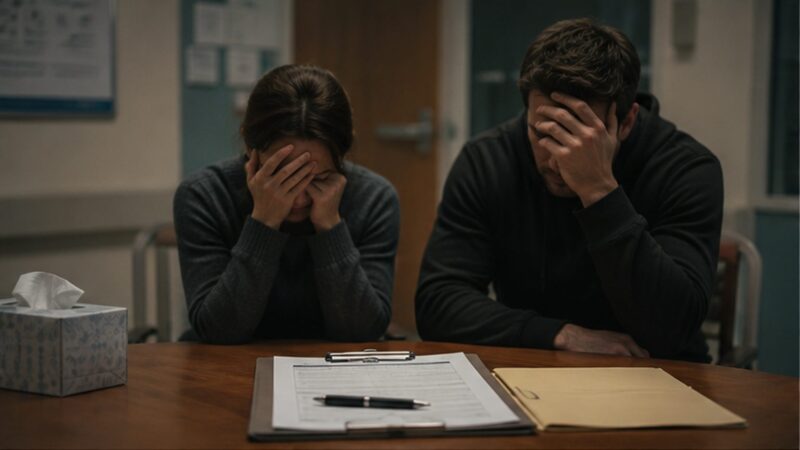
The papers were placed in front of me while Sophie sat across the room in a nurse’s arms wearing the same pink cardigan Daniel had bought before she was born.
When Sophie saw me, she smiled and reached toward me.
“Mama.”
I almost stood up.
“I can’t do this,” I whispered.
Daniel was crying beside me.
“We need to think about what’s best for her.”
My hand shook so badly that my signature barely looked like my name.
Before we left, the nurse let me hold Sophie one last time.
She rested her head against my chest exactly the way she had the day she was born.
I kissed her hair and whispered, “I waited eleven years for you. I don’t know why I’m walking away from you now.”
Then the nurse took her from my arms.
Daniel and I walked toward the hospital exit in complete silence.
We had almost reached the parking lot when I heard someone running behind us.
“Mrs. Carter!”
I turned.
It was Sophie’s nurse.
She was holding a folded document and looking directly at me.
“Please don’t leave yet.”
My heart dropped.
“Is Sophie okay?”
“She’s fine. But there’s something you need to know.”
Daniel suddenly went pale.
The nurse looked at him, then back at me.
“Mrs. Carter… you need to know what your husband asked us to do after you signed those papers.”
I looked at Daniel, and for the first time I realized that he had been hiding something from me.
Something the nurse believed I needed to know before I left my daughter behind forever.
I couldn’t fit the rest of Sophie’s story here. In the first comment, I shared what the nurse told me, what Daniel had done behind my back, and what happened when I realized I might still have time to turn around and run back to my daughter. Read the continuation below 👉👉‼️‼️⬇️⬇️
If you don’t see it, change the comment setting from “Most Relevant” to “All Comments.” 👇👇
PART 2
I stood in the hospital entrance staring at the nurse while Daniel remained beside me, completely silent.
“What did he ask you to do?” I finally managed to say.
The nurse unfolded the document in her hand and explained that after I had signed the papers, Daniel had asked the social worker not to process anything until he had signed too. Then, while I was saying goodbye to Sophie, he had quietly asked whether we could still change our minds if one of us refused to complete the final paperwork.
I turned toward him.
“You knew we could still stop this?”
Daniel’s eyes immediately filled with tears.
“I didn’t know what I wanted anymore.”
I felt anger rise through all the grief that had been sitting inside me.
“You spent weeks convincing me that giving her up was the right thing to do.”
“I know.”
“You watched me sign.”
“I know, Emily.”
“Then why would you ask them to wait?”
Daniel wiped his face with both hands before answering.
“Because when they took her away from you, she started crying.”
His voice broke.
“She kept looking toward the door you had walked through, and I couldn’t stand it. I asked the nurse if I could hold her one last time.”
The nurse quietly added that Sophie had stopped crying almost immediately after Daniel picked her up.
Daniel looked at me then, and I saw the same man who had once carried our daughter through the hallway at two in the morning, thanking her for every cry because we had waited eleven years to hear them.
“She put her head on my chest,” he whispered. “And I suddenly realized how insane I had been. I was so afraid of losing her in ten years, or fifteen years, or whenever that day comes, that I was willing to lose her today.”
I couldn’t speak.
Daniel reached into his jacket and pulled out the pen the social worker had given him.
“I never signed.”
My eyes dropped to the pen.
For weeks I had believed Daniel was the stronger one because he could talk about giving Sophie away without falling apart. Standing there, I finally understood that he hadn’t been stronger at all.
He had simply been more frightened than I was.
“Where is she?” I asked.
The nurse looked back toward the elevators.
“Upstairs.”

I didn’t wait for Daniel.
I turned and ran.
I still remember the sound of my shoes against the hospital floor and how badly my chest hurt as I reached the elevator. I kept thinking about Sophie stretching her arms toward me and calling “Mama” while I sat at that table with a pen in my hand.
When the elevator doors opened, I almost collided with another nurse.
Then I saw Daniel’s empty chair outside Sophie’s room.
And through the doorway, I saw my daughter.
She was sitting in the first nurse’s lap, holding the little pink cardigan between her fingers.
The moment Sophie saw me, she smiled.
That smile is something I will carry with me for the rest of my life.
She reached both arms toward me.
“Mama.”
I picked her up and held her so tightly that she protested with a little sound.
“I’m sorry,” I whispered into her hair. “I’m so sorry. Mommy got scared.”
A few moments later, Daniel entered the room.
He stopped several feet away from us.
Sophie looked at him and immediately reached one hand toward him too.
“Dada.”
Daniel covered his mouth.
Then he came over, wrapped both arms around us, and the three of us cried together.
The paperwork was stopped that afternoon.
We took Sophie home.
I wish I could say that after that day everything became easy, but it didn’t.
Progeria did not disappear because we loved her.
There were specialists, medications, physical therapy, frightening appointments and nights when Daniel and I lay awake listening to Sophie breathe because neither of us wanted to admit how scared we were.
As she grew older, her body changed faster than other children’s bodies did, and eventually she began noticing that people looked at her differently.
When Sophie was seven, she came home from school unusually quiet.
I asked what was wrong, and after a long silence she told me that a boy had asked why she looked like “a little old lady.”
I went into the bathroom later and cried where she couldn’t see me.
Daniel handled it differently.
He sat beside her on the couch and showed her one of his own childhood photographs.
“You know what I see when I look at you?” he asked.
Sophie shrugged.
“My daughter.”
She smiled.
“That’s it?”
Daniel kissed the top of her head.
“That’s everything.”
As Sophie grew older, we told her more about her condition. We never wanted her to discover the truth from another child or from something she found online.
By thirteen, she understood that her life might be shorter than most people’s.
One evening, she asked us the question Daniel had feared since the day of her diagnosis.
“Am I going to die young?”
Daniel’s hand tightened around mine.
I wanted to lie.
I wanted to tell her she would be eighty years old someday and complain about her grandchildren being too loud.
Instead, we told her that nobody could know exactly how much time they had, but that her illness could make her life shorter.
Sophie sat quietly for a while.
Then she asked:
“Are you sad you got me?”
I felt as though someone had punched me in the chest.
“No.”
She looked at Daniel.
He was already crying.
Then he did something I never expected.
He told her about the hospital.
Not every painful detail, but enough.
He told her that when she was little, fear had made him believe he wasn’t strong enough to be her father.
Sophie listened without interrupting.
When he finished, she asked:
“So you almost left me?”
Daniel nodded.
“Yes.”
“Why?”
“Because I loved you so much that I was terrified of how badly it would hurt if I lost you.”
Sophie frowned in the thoughtful way she always did.
Then she said:
“That doesn’t make sense, Dad.”
Daniel laughed through his tears.
“No. It doesn’t.”
She leaned against him.
“I’m glad you got smarter.”
That was Sophie.
She could make us cry and laugh within the same minute.
She loved strawberry milkshakes, old songs, ridiculous jokes and sunsets. She hated hospitals but loved nurses. Every birthday she insisted that we take too many photographs because, as she once told me, “Pictures are how you make a day stay.”
Sophie reached her sixteenth birthday.
By then, her health had become more fragile, and we knew time was changing.
But she refused to let every conversation become about illness.
On her sixteenth birthday, she made Daniel buy seventeen candles.
“You’re sixteen,” he reminded her.
“I know.”
“Then why seventeen?”
She grinned.
“One for next year. I’m reserving it.”
Daniel turned away because he didn’t want her to see him cry.
Several months later, Sophie was admitted to the hospital.
This time there were no papers asking us whether we wanted to leave her.
There was only a chair on each side of her bed.
Daniel sat in one.
I sat in the other.
And neither of us moved.
One evening, Sophie asked me to take a folded envelope from her drawer.
On the front she had written:
FOR MOM AND DAD — NOT YET.
I hated those last two words.
Sophie died nine days later.
She was sixteen.
Daniel held one of her hands.
I held the other.
For eleven years we had begged for a child, and when she finally came, sixteen years suddenly felt impossibly short.
We waited almost a month before opening her envelope.
Inside was one page written in Sophie’s uneven handwriting.
She had written:
“Please don’t spend the rest of your lives saying I didn’t live long enough. I know I didn’t get as many years as other people, but I got you. I got birthdays, school, friends, music, milkshakes, the ocean, bad jokes, and a home where I always knew I was loved.”
I had to stop reading because I couldn’t see through my tears.
Daniel continued.
At the bottom, Sophie had written one last sentence.
“And Dad, thank you for not signing that paper.”
Daniel pressed the letter against his chest and cried harder than I had seen him cry since the day we learned I was pregnant.
Sometimes I still think about that hospital entrance all those years ago.
I think about how close we came to getting into the car.
How close I came to allowing fear to make the most important decision of my life.
And I think about the little girl waiting upstairs, completely unaware that her parents were deciding whether loving her would hurt too much.
Sophie’s life was shorter than I wanted.
I would have taken another year, another month, another morning with her if someone had offered it to me.
But when I remember those sixteen years, I no longer think first about the disease that took her from us.
I remember the little pink cardigan.
Her hand wrapped around Daniel’s finger.
The way she yelled “Mama” when I walked into a room.
The seventeen candles on her sixteenth birthday cake.
And the sentence she left behind for the two frightened parents who had once almost walked away from her:
“Thank you for choosing me even though you knew you might lose me.”
For eleven years, Daniel and I believed our greatest pain was not being able to have a child.
We were wrong.
Our greatest fear became losing the daughter we finally had.
But Sophie taught us something neither of us understood when she was diagnosed:
Knowing that love may end in heartbreak is not a reason to walk away from it. Sometimes it is the reason to hold on even tighter.