
“I Speak 15 Languages,” the Young Woman Said Calmly in Court… The Whole Room Laughed, and Even the Judge Smirked — But the Truth Left Everyone in Shock 😱😱
PART 1
The judge looked exhausted.
He had been listening to the same case for hours, and it showed. His hand was pressed against his forehead, his eyes were half-closed, and every few seconds he looked like he was fighting sleep.
Then the young woman standing before him spoke.
Her name was Elena Morales, a 24-year-old Latina accused of helping forge the translation of an international business contract that had cost a wealthy investor millions. According to the prosecution, Elena had knowingly translated key legal pages and helped deceive the victim.
But Elena kept insisting on the same thing.
“I had nothing to do with it.”
No one in the courtroom seemed to believe her.
The prosecutor placed a document in front of her and asked coldly,
“Then how do you explain that your name is attached to the translation file?”
Elena swallowed, lifted her chin, and answered,
“Because someone used my name.”
A few people in the room whispered.
The judge sighed heavily, clearly irritated.
“And why would anyone use your name?” he asked.
Elena replied calmly,
“Because I speak 15 languages.”
For one second, the room was silent.
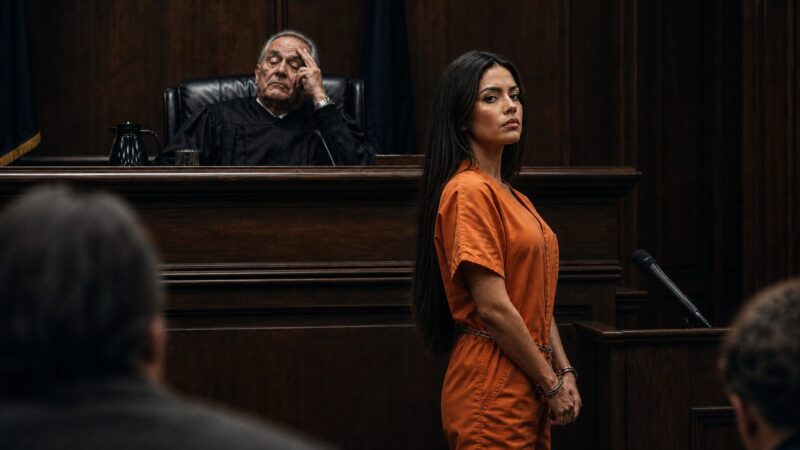
Then laughter broke out across the courtroom.
Even the judge couldn’t control himself. He smirked, then laughed openly and said,
“You can barely speak proper English.”
More laughter followed.
Elena slowly turned her head and stared at him with a cold, furious look.
Then she leaned toward the microphone and said something that made the entire courtroom go quiet.
“That is exactly why they chose me.”
The judge’s smile faded.
Elena pointed at the contract on the table.
“The one mistake in that document proves I didn’t translate it.”
Now everyone was listening.
Then she asked for permission to read one sentence from the contract aloud.
And when she translated it correctly, the prosecutor’s face turned pale.
😱⚖️‼️
Why was Elena accused of a crime she didn’t commit, and what was hidden inside the contract that proved someone else had framed her?
👉 Read Part 2 here. You’ll be shocked when you find out the truth.
PART 2 — Full Story
The laughter disappeared so quickly that the silence felt heavy.
The judge straightened in his chair for the first time all day.
“What do you mean,” he said slowly, “that one mistake proves you didn’t translate it?”
Elena took a deep breath. Her hands were trembling, but her eyes were steady now.
“The contract was submitted as a certified translation,” she said. “The court was told that I translated it from Portuguese and Romanian into English.”
The prosecutor folded his arms.
“And your name appears on the translation file.”
“Yes,” Elena said. “But whoever forged that file made a mistake.”
The judge frowned.
“What mistake?”
Elena pointed to the second page.
“This section says the investor agreed to a temporary transfer of control over his company shares.”
The businessman, Richard Hale, who was seated near the front, looked up sharply. That clause was the one that had ruined him.
Elena continued,
“But that is not what the original sentence says.”
The judge looked at the court-appointed translator.
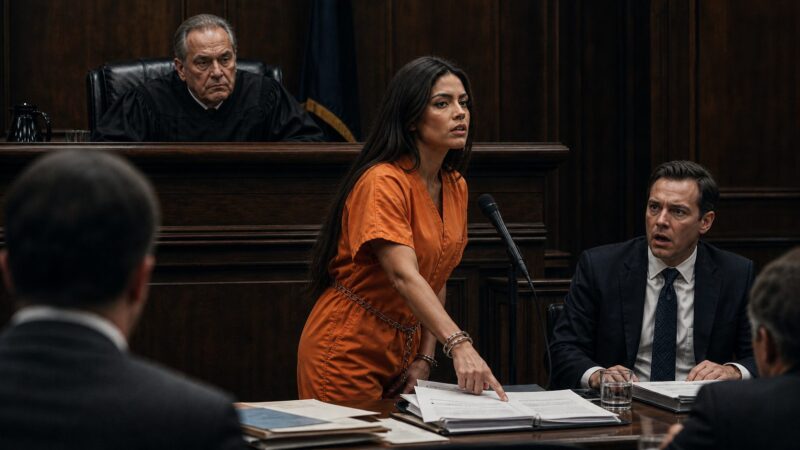
“Is that true?”
The translator adjusted his glasses, looked down at the document, and after a few seconds his expression changed.
He cleared his throat.
“She is correct, Your Honor.”
A murmur spread through the courtroom.
Elena pointed again.
“The original sentence does not say temporary transfer. It says irreversible transfer of ownership rights.”
Richard Hale shot to his feet.
“What?!”
His attorney pulled him back down, whispering urgently.
The judge’s face darkened.
“Why was this discrepancy not flagged?”
The prosecutor looked uncomfortable.
“The certified translation presented to the court stated temporary transfer.”
“That’s because the translation is fake,” Elena said firmly.
The judge looked at her closely.
“And how can you be so sure?”
Elena lifted the paper.
“Because no real translator who speaks those languages would make this particular mistake.”
The judge narrowed his eyes.
“Explain.”
She did.
“In Portuguese, the legal phrase used here has a very specific meaning. In Romanian, the supporting clause confirms it. The wording refers to permanent relinquishment, not temporary protection. Whoever forged this either relied on machine translation or only understood the languages superficially.”
The judge said nothing.
Elena continued.
“And there’s more.”
She opened her folder and removed several papers.
“My real certification number expired from business translation work two years ago. After that, I only worked in community interpretation. Medical, school, and immigration support. Not corporate contracts.”
She laid the documents on the table.
“And the translation file attached to this case uses the wrong certification number.”
The court clerk examined the papers and handed them to the judge.
The judge’s sleepy expression was gone now.
He turned toward Elena.
“You said they chose you because you speak 15 languages. Why?”
Elena’s eyes briefly filled with tears, but her voice remained calm.
“Because I’m easy to underestimate.”
The room stayed silent.
She looked at the judge.
“You laughed because I don’t sound polished. Because my English gets rough when I’m nervous. Because I grew up moving from country to country, learning languages in shelters, clinics, embassies, and border offices—not in elite schools.”
Then she looked at the prosecutor.
“And the people who framed me knew exactly what others would think when they heard me speak.”
The prosecutor shifted uncomfortably.
The judge leaned forward.
“Who framed you?”
Elena turned slowly and looked toward the plaintiff’s legal team.
At first, no one reacted.
Then she pointed directly at Richard Hale’s senior attorney, Daniel Mercer.
The room froze.
Mercer forced a laugh.
“This is absurd.”
Elena pulled out her phone.
“No,” she said quietly. “What’s absurd is that you thought no one would notice the language pattern you kept repeating.”
The judge raised a hand.
“What do you mean?”
Elena tapped the screen and handed the phone to the bailiff, who connected it to the courtroom speaker.
A recording began to play.
At first, there was static.
Then a man’s voice came through.
“Use someone nobody will defend. Someone foreign. Someone young. Someone who sounds confused when she talks.”
Another voice asked,
“What if she understands the languages?”
The first man laughed.
“She may know them, but the court won’t believe her.”
Every eye in the room turned toward Daniel Mercer.
His face had gone white.
Richard Hale stared at him in disbelief.
The judge spoke sharply.
“Whose voice is that?”
Mercer opened his mouth, but nothing came out.
Elena answered for him.
“It’s his. He approached me three months ago and asked me to review one page of a bilingual memo. I refused when I realized it was part of something larger. A week later, my identity was attached to the forged translation.”
The judge’s expression hardened.
“You had this recording the whole time?”
Elena nodded.
“It was sent to me anonymously two nights ago. I didn’t know who had recorded it until I heard Mr. Mercer speak again in court today. His voice pattern is unmistakable.”
The prosecutor requested a recess immediately.
But the judge refused.
“No. We continue now.”
Then he turned to Elena.
“Miss Morales, explain everything from the beginning.”
So she did.
Elena had worked for years as a freelance interpreter. She really did speak 15 languages—Spanish, English, Portuguese, Romanian, Italian, French, German, Arabic, Russian, Ukrainian, Turkish, Polish, Dutch, Mandarin, and basic Korean. She had learned them not from status or privilege, but from necessity, movement, and survival. Her mother had worked aid jobs across different countries, and Elena grew up translating for families who couldn’t afford professionals.
Months earlier, Mercer had contacted her through a referral, pretending he needed help checking terminology in a multilingual business document. She reviewed a short paragraph, realized the case involved high-value asset transfer, and refused to continue without formal paperwork.
Then someone stole her credentials, forged her digital signature, and attached her name to a fraudulent translation that misled Richard Hale into signing away control of his company.
When the fraud surfaced, Elena became the perfect scapegoat.
Young.
Nervous.
Not rich.
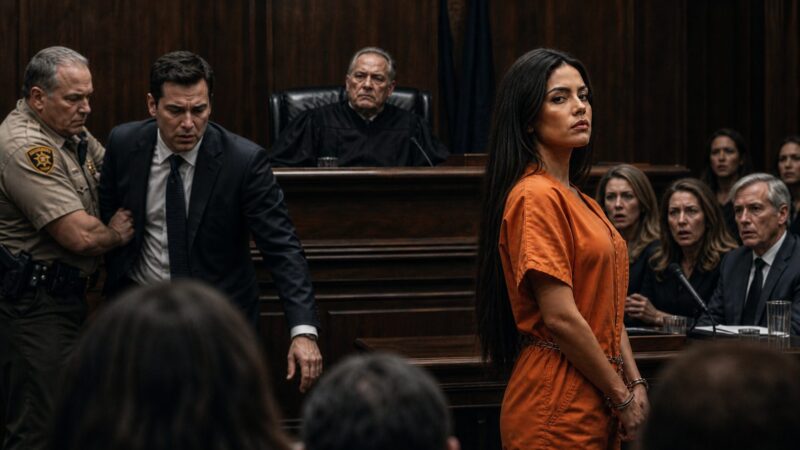
Not powerful.
And, as Mercer assumed, easy to laugh at.
But Mercer had made one fatal mistake: he believed she would not be able to defend herself under pressure.
He was wrong.
Elena turned toward the judge and said quietly,
“The reason I said I speak 15 languages wasn’t to impress anyone. It was because language is the only reason I’m still standing here. It’s the reason I knew that contract was wrong. And it’s the reason I knew I was being framed.”
The judge looked at her for a long moment.
Then he removed his glasses.
“Miss Morales,” he said, “this court owes you an apology.”
Elena met his eyes.
“With respect, Your Honor, I need more than an apology.”
The judge nodded slowly.
“You need justice.”
He ordered the bailiff to seize Mercer’s devices and instructed the court to suspend the charges against Elena pending a full criminal investigation.
Richard Hale sat motionless, stunned that the very lawyer he trusted had orchestrated the deception.
As Mercer was escorted out, he tried to speak.
But for once, no one wanted to hear him.
The hearing ended in complete silence.
The same people who had laughed at Elena earlier now avoided her eyes.
Before leaving the courtroom, she turned once more toward the judge.
“You laughed because I didn’t sound important,” she said.
The judge lowered his head.
Elena added,
“Next time, maybe listen before you decide who is intelligent and who is guilty.”
Then she walked out of the courtroom with her head high.
And no one laughed.
Because the young woman they mocked for claiming she spoke 15 languages had just used them to expose the one lie that nearly destroyed her life.
Начало формы
Конец формы